Why B2B Commerce Needs Its Own AI Agents
AI wasn't built for B2B. See why consumer AI agents fail at custom pricing, approval chains & complex catalogs and what purpose-built B2B agents do differently

Why B2B Commerce Needs Its Own AI Agents
Your finance director just tried ChatGPT for procurement. She asked: "Find me the best industrial fastener supplier in North America, 50,000 bolts, delivery in 6 weeks, under $3 per unit."
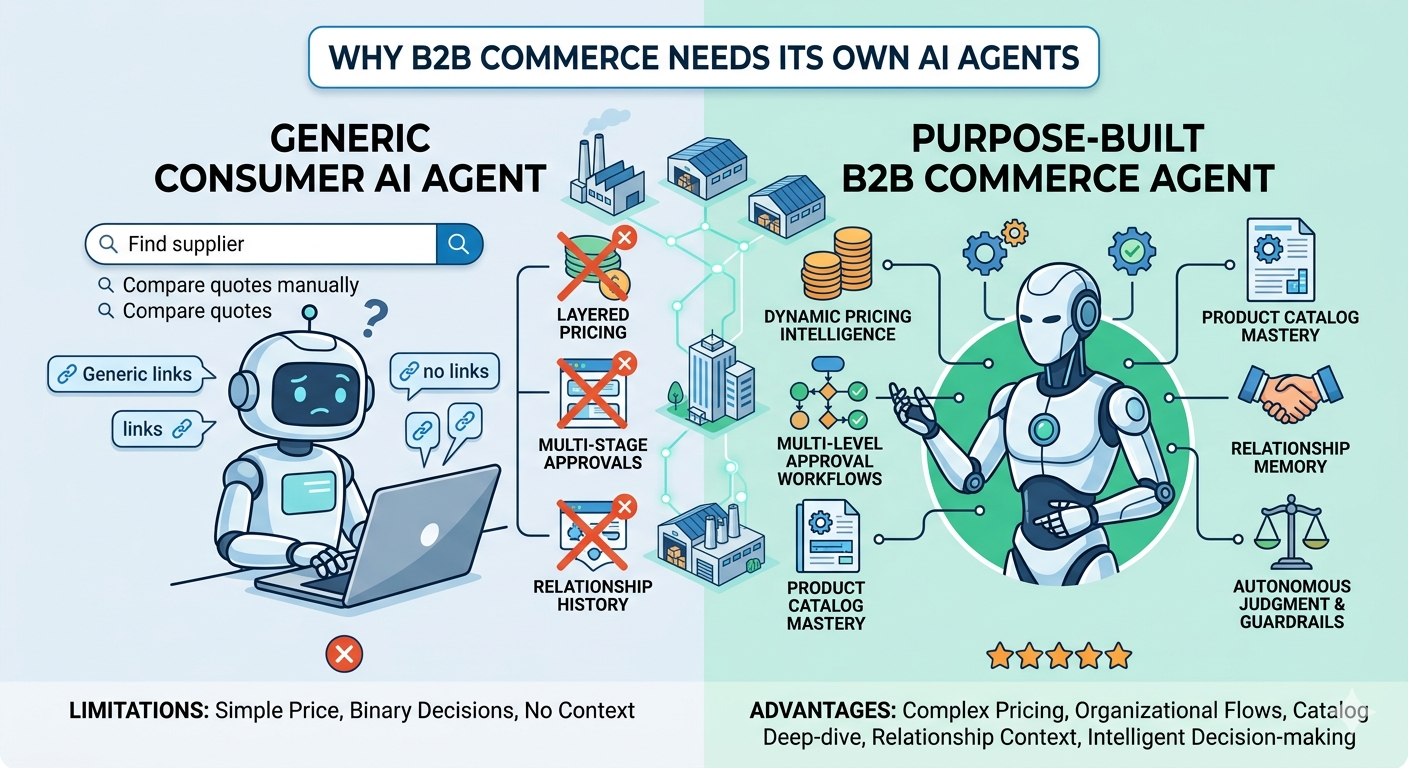
ChatGPT returned three generic links to supplier directories. It recommended she "contact local distributors" and "compare quotes manually."
She closed the tab and made the calls herself.
This is the story repeating across B2B companies everywhere. ChatGPT, Gemini, Claude, they're extraordinary tools for knowledge work. But they're not designed for commerce. And more importantly, they're not designed for B2B commerce, which operates in a fundamentally different universe than the consumer retail they were trained on.
Why Consumer AI Agents Fail in B2B
Pricing: In B2C, price is public, $49.99, fixed, universal. In B2B, price depends on volume, customer tier, contract terms, delivery date, relationship history, and dozens of other variables. The same buyer may pay $40/unit or $60/unit for identical SKUs depending on context. A consumer AI agent has no framework for this. It assumes pricing is legible and stable. In B2B, pricing is the negotiation.
Approval Workflows: In B2C, you click "buy" and payment processes. Done. In B2B, a purchase request routes to department managers, finance, compliance, sometimes legal. Approval thresholds vary, $5K vs $50K vs $500K. Contract reviews happen. Budget codes get assigned. Procurement policies enforce vendor lists, insurance requirements, and payment terms. A consumer AI agent assumes the person asking is the decision-maker. In B2B, the asker is often not the buyer.
Product Complexity: B2C products have descriptions, prices, reviews, and shipping times. B2B products have technical specifications, compliance certifications, lead times across multiple SKU variants, substitution logic, quality standards, and historical performance data. A consumer AI agent can read a spec sheet. But it can't navigate the jungle of B2B product logic.
Relationship Context: In B2C, each transaction is independent. In B2B, everything is relationship-based. This customer has been with you for 12 years. They're 18% of your revenue. They're price-sensitive but quality-focused. They have a preferred payment term structure. One of your sales reps has built trust over years. Losing them to a competitor is catastrophic. A consumer AI agent has no institutional memory, it sees every inquiry as a new transaction.
Exceptions and Judgment Calls: In B2C, "that item is out of stock" leads to a binary substitute-or-not decision. In B2B, it sounds like this: "That part is on backorder 8 weeks. We have three alternatives. The first costs 3% more but has identical specs. The second costs 18% less but requires 500-unit minimums. The third is our proprietary solution — better long-term value but different specs. What's your priority: cost, availability, or performance?" A consumer AI agent can provide options. It can't weigh customer value, margin impact, competitive risk, and relationship dynamics simultaneously.
The B2B Agent Difference
A purpose-built B2B commerce agent operates with a completely different architecture.
1. Pricing Intelligence — It understands your internal pricing engine. It knows base list prices for every SKU, volume discount thresholds and percentages, contract pricing for specific customers, geographic pricing variations, seasonal adjustments and promotional pricing, and margin guardrails. When a buyer asks for a quote, the agent doesn't search the internet. It navigates internal complexity.
2. Approval Logic — It models the organization's governance. It knows which roles approve what dollar amounts, how long each approval stage typically takes, which customers need procurement policy reviews, which items require compliance sign-offs, and how to route exceptions and flag expedited paths. It doesn't just execute transactions. It facilitates organizational decision-making.
⏱️ How many deals did you lose this week to slow quotes? The number might shock you. See SalesPulse turn an RFQ into a quote in under 5 minutes →
3. Catalog Mastery — It's trained on your actual catalog, not the internet. It understands your SKU taxonomy and how variations relate, technical specifications in the context of your product ecosystem, historical substitutions and what customers accepted, which products are high-margin or high-risk, and how your catalog maps to competitors' catalogs for benchmarking. It doesn't search Google. It understands your actual business.
4. Relationship Memory — It tracks historical patterns: what this customer bought last quarter, their typical order size and timing, which products they're loyal to versus which they shop around for, payment reliability and preferred terms, which sales rep they trust, and win/loss patterns with competitors. It doesn't reset the conversation. It builds on years of relationship data.
5. Autonomous Judgment — It operates within guardrails set by your leadership: approve quotes under $25K without human intervention, flag potential margin erosion without blocking it, suggest alternatives when inventory is constrained, negotiate within predefined parameters, and escalate exceptions to humans. It doesn't ask permission for every decision. It makes intelligent calls within your risk tolerance.
The Cost of Not Having B2B Agents
Response Speed: Your distributor takes 3–5 days to quote. The buyer goes to the first responder who quoted in 2 hours. You lose 15–20% of deals to latency alone.
Sales Productivity: Salespeople spend 40% of their time assembling quotes instead of selling. At a loaded cost of $150K/year per seller, that's $60K/year per seller in non-selling labor. For a team of 10 sellers: $600K/year lost to manual quote work.
Inventory Inefficiency: Without demand prediction, you carry excess safety stock, expensive or face stockouts, lose sales. McKinsey found AI-driven procurement can unlock 25–40% efficiency gains, meaning you're leaving 25–40% of cost on the table.
Margin Erosion: Without dynamic pricing, your salespeople guess at discounts. Some give away margin to close deals. Some leave money on the table by quoting too high. Average variance: 12–15% of potential margin lost. Without relationship intelligence, you treat all customers identically, your highest-value customer gets the same experience as a transactional buyer, and churn risk increases.
Why Now Matters
For the last decade, B2B companies justified staying manual: "Our business is complex. Custom solutions are expensive. We'd rather optimize the core than overhaul everything."
That calculus has changed. Purpose-built B2B AI agents now exist. They don't require ripping out ERP systems or rebuilding catalogs. They integrate with what you have.
Forrester research shows 20% of B2B sellers will face AI-driven negotiations in 2026 — that's 20% of your customer base buying differently than they do today, through agents that make faster decisions, compare more options, and accept only structured data.
Your customers are already thinking in agent terms. The question is whether you can talk to their agents or whether you're still expecting them to talk to your humans.
📅 20% of your buyers are already negotiating via AI agents. Are you ready to respond? Start your 5-day CommerceFlow pilot — no integration required →
The Transition from Consumer to B2B AI
The path is becoming clear. Phase 1 (2023–2024): Consumer AI models mature. Enterprises experiment, ChatGPT for content, Gemini for research. Phase 2 (2025): Domain-specific agents emerge for vertical use cases, healthcare AI, financial services AI, B2B commerce AI. Phase 3 (2026+): Purpose-built agents become baseline infrastructure. Companies without them look slow and inefficient. Those with them have structural competitive advantage.
You are in Phase 2–3 right now.
The companies deploying purpose-built B2B commerce agents in the next 6–12 months will establish operational advantages that take competitors years to replicate: faster response leading to higher win rates, better pricing leading to higher margins, predictable supply leading to lower inventory costs, and relationship intelligence leading to lower churn.
Waiting for "the market to settle" or "agents to mature" is actually a delay tactic that costs you revenue and share.
What Purpose-Built Looks Like
A B2B commerce agent purpose-built for distribution and manufacturing learns your pricing engine, not Google's search results. It understands your approval workflows — not generic purchasing. It navigates your catalog, not the entire internet. It remembers customer relationships, not just current sessions. And it makes decisions within your risk guardrails, not its own biases.
This isn't a chatbot. It's not a co-pilot. It's a sales and procurement system that operates autonomously within your business logic.
Your procurement team doesn't need a better search engine. Your sales team doesn't need a writing assistant. You need an AI agent that understands B2B commerce the way your business does. That's the difference between a tool and a transformation.
CommerceFlow's agents — SalesPulse, ContentPulse, and RevPulse — are purpose-built for B2B commerce. They learn your pricing, catalogs, and workflows — not generic retail patterns. See how leading B2B distributors and manufacturers are closing deals faster →