The Hidden Cost of Slow Quotes: How B2B Distributors Lose $500K/Year
Slow B2B quotes cost distributors $500K+ a year in lost deals, wasted labor & margin erosion. Here's the math and how quote automation fixes.

The Hidden Cost of Slow Quotes: How B2B Distributors Lose $500K/Year
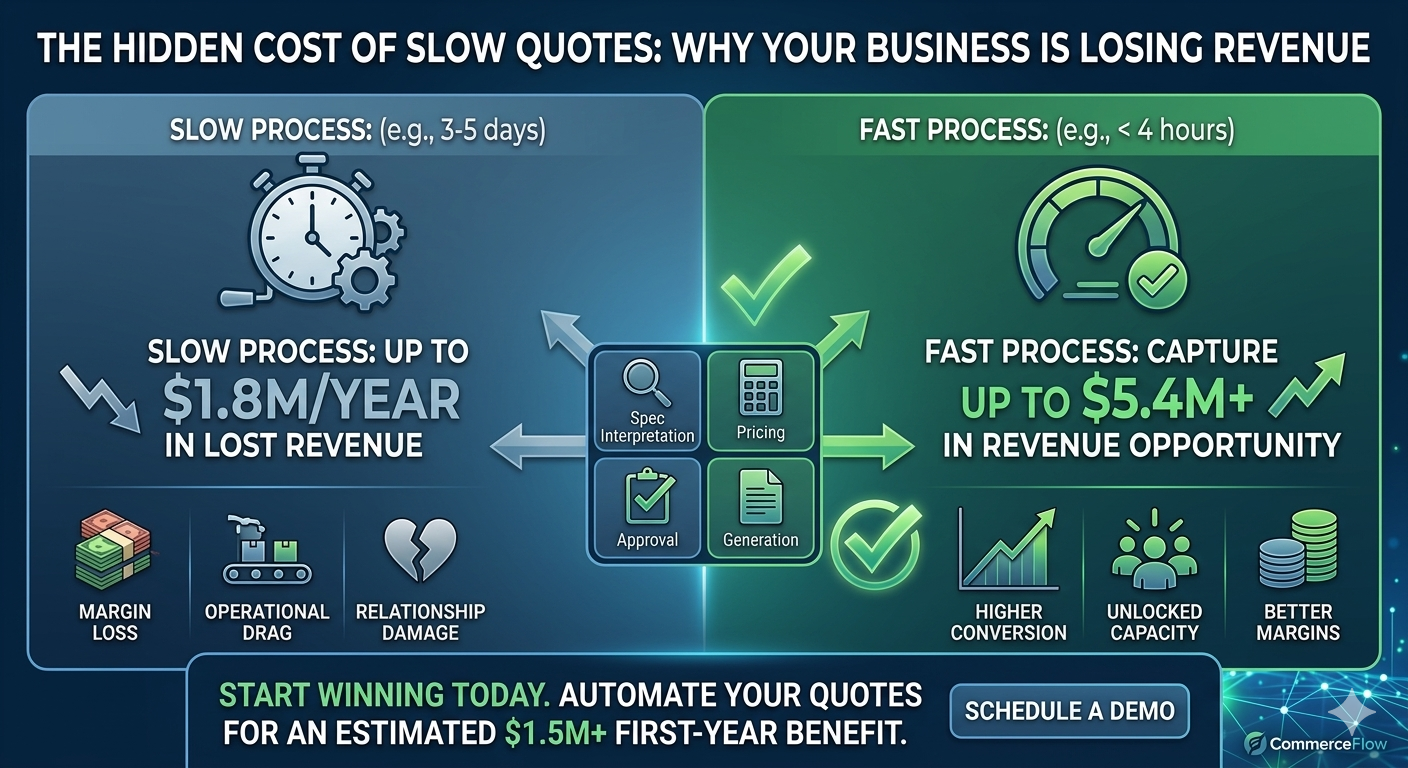
A mid-market B2B distributor processes 50 quote requests per week. Here's what typically happens. Request arrives Monday morning. Sales rep pulls the spec sheet, opens the pricing spreadsheet, cross-references the customer's contract terms. Finance needs to approve contract pricing for this customer tier. Rep sends quote on Wednesday — 3 business days later. Buyer compares to three competitors' quotes, all faster. Buyer goes with the first responder.
This happens 10 times per week. That's roughly 500 deals per year lost — not to price, not to product quality, but to response speed alone.
The actual financial impact is staggering.
The Calculation
Here are the inputs for a real mid-market distributor: average deal size of $35,000, average quote response time of 3–5 business days, and industry data showing 15–20% of B2B buyers move forward with the first responder — with a 10% conversion rate for fast responders vs. 4% for slow ones.
Baseline Scenario — Without Quote Acceleration:
- 50 quote requests/week × 52 weeks = 2,600 quotes/year
- 2,600 quotes × 4% conversion rate = 104 deals closed
- 104 deals × $35,000 = $3.64M in closed revenue
Scenario With Fast Response — Under 4 Hours:
- 2,600 quotes × 10% conversion rate = 260 deals closed
- 260 deals × $35,000 = $9.1M in closed revenue
- Revenue Opportunity: $5.46M
More Conservative Scenario — Moving from 3–5 Days to Same-Day:
- Moving conversion from 4% to 6% = 52 additional deals/year
- 52 deals × $35,000 = $1.82M in incremental revenue
Even using conservative assumptions, slow quotes cost $1.8M/year in lost revenue.
📊 $1.8M in lost revenue from slow quotes alone. See what CommerceFlow recovered for distributors like you. Read real results from real B2B distributors →
But It Gets Worse
That $1.8M figure only accounts for deals lost to the first responder. It doesn't account for margin compression, operational drag, or relationship damage.
1. Margin Compression — Sales reps don't have time to think. They quote quickly by applying the standard discount. They don't analyze what this customer typically pays, model volume-based pricing incentives, suggest contract terms that preserve margin, or flag upsell opportunities. Result: you hit your revenue target but with 3–5% lower margin than you could have captured. For $3.64M in revenue, a 4% margin improvement = $145K in additional profit left on the table.
2. Operational Drag — If each quote takes 2 hours across the organization — 1 hour from sales, 0.5 from finance, 0.5 from pricing — and you process 2,600 quotes per year, that's 5,200 hours per year. At a fully-loaded cost of $75/hour, that's $390K/year in labor that delivers zero revenue. It just holds up the sale.
3. Relationship Damage — Slow quotes signal to customers: "You're not that important to us." A buyer who waits 5 days while competitors respond in 4 hours learns one thing: this distributor is slow. Even if your quote was perfect, the perception sticks. You're now in the "backup supplier" category. This manifests as lower order frequency and smaller deals — a 5–8% annual revenue decline from lost relationship quality alone.
The Real Problem: Quote Assembly
Here's what actually takes time. Spec interpretation takes 30 minutes — what does the customer actually need, cross-referencing SKUs, identifying equivalent products, checking inventory. Pricing calculation takes 45 minutes — what discount tier applies, is there contract pricing, what's the volume multiplier, do we need approval for exception pricing, what about shipping. Approval routing takes 1–3 hours or a full next-day delay. Document generation and delivery takes 15 minutes. Back-and-forth with the customer stretches across 2–4 hours spread over multiple days.
Total: 3–5 days is not an exaggeration. It's structural.
And here's the cruel irony: the customer doesn't care about the work involved. They only care about the result arriving fast.
Why Salespeople Spend 40% of Their Time on Quotes
According to Forrester, HubSpot, and McKinsey, field sales reps spend 40% of their time on quote creation and proposal work instead of selling. At a typical quota of $500K per rep per year with a 50% close rate, each rep needs to generate $1M in pipeline annually. If they're spending 40% of their time on quotes, that's equivalent to losing 40% of their sales capacity.
For a team of 10 salespeople, the combined quota is $5M per year. The equivalent sales capacity lost to quote work is $2M per year — the output of 4 full-time salespeople being used for administrative work. If you hired 4 more salespeople to recapture that capacity, you'd spend $600K per year for maybe $1.5–2M in incremental revenue. Quote automation delivers a 3–4x better ROI.
The Competitive Window
Here's what's happening in the market right now. Leaders — 20–30% of mid-market distributors — are deploying quote automation, responding to RFQs in under 4 hours, winning 10–15% of deals on speed alone, and building customer preference for their responsiveness. Followers — 50–60% of mid-market distributors — are aware they're slow but believe quote automation is too expensive, still processing quotes manually, and losing 2–3% of business annually to faster competitors. Laggards — 10–20% of mid-market distributors — don't track why they lose deals, blame product or price for share loss, and will be acquired or consolidated out within 5 years.
The competitive window is open right now. Moving from 3–5 days to 4 hours gives you a 2–3 year advantage before competitors catch up.
⏱️ How many deals did you lose this week to slow quotes? The number might shock you. See SalesPulse turn an RFQ into a quote in under 5 minutes →
The Solution Framework
Eliminating quote delays requires three things.
1. Spec-to-SKU Intelligence — Instantly understand what the customer needs, map it to your products, and identify alternatives. This is 50% of quote time. Eliminate it with AI-assisted matching.
2. Dynamic Pricing — Your pricing engine should be alive. It should apply contract terms, volume discounts, geographic adjustments, and approval guardrails in real-time. Don't wait for finance — automate the guardrails.
3. Autonomous Quote Generation — For deals within predefined parameters — customer is approved, deal size is under $50K, products are in stock — the system generates and sends the quote without human intervention.
All three require integration with your ERP and pricing engine, understanding of your approval workflows, continuous learning from historical quote data, and agents that make intelligent decisions within guardrails. This isn't simple. But it's no longer custom-build expensive. Purpose-built B2B commerce platforms can deploy this in 8–12 weeks.
The Payback Math
Assuming you implement quote acceleration, the conservative benefits look like this:
- 10 additional deals/quarter from speed advantage: 40 deals/year × $35K = $1.4M
- 2% margin improvement from better pricing strategy: $3.64M × 2% = $73K
- 10% reduction in labor spent on quotes: $390K × 10% = $39K
- Total first-year benefit: $1.51M
- Implementation cost: $40K–$80K
- ROI: 18–38x return in year one
And that's before accounting for improved customer satisfaction and retention, better pricing intelligence, faster market response to demand shifts, and reduced operational friction.
The Question Is Not "Can We Afford It?"
The question is: "Can we afford not to?"
Every quarter you delay quote automation, you're leaving $400–500K on the table. You're training your customers to expect slow responses. You're burning out salespeople on administrative work.
The leaders in your space are already moving. In 12 months, they'll have 2 years of experience with agent-driven quoting. They'll have trained customers who expect 4-hour responses. They'll have internal processes optimized around speed.
By then, catching up will require not just deploying the same technology — it will require changing customer expectations that are already established.
This isn't about adopting technology. It's about not losing $500K/year to avoidable delays.
CommerceFlow's SalesPulse agent learns your pricing, catalogs, and approval workflows — then generates and delivers quotes in minutes, not days. See how distributors are recapturing the deals they were losing to slow response times. Schedule a demo →