Is Your B2B Product Catalog Ready for AI Agents? A Readiness Checklist
Can AI procurement agents navigate your B2B catalog? Use this 6-point readiness checklist to score your catalog.

Is Your B2B Product Catalog Ready for AI Agents? A Readiness Checklist
You have 50,000 SKUs. Your catalog is "complete." Sales teams use it. Customers find products.
But here's the question: Can an AI agent navigate it?
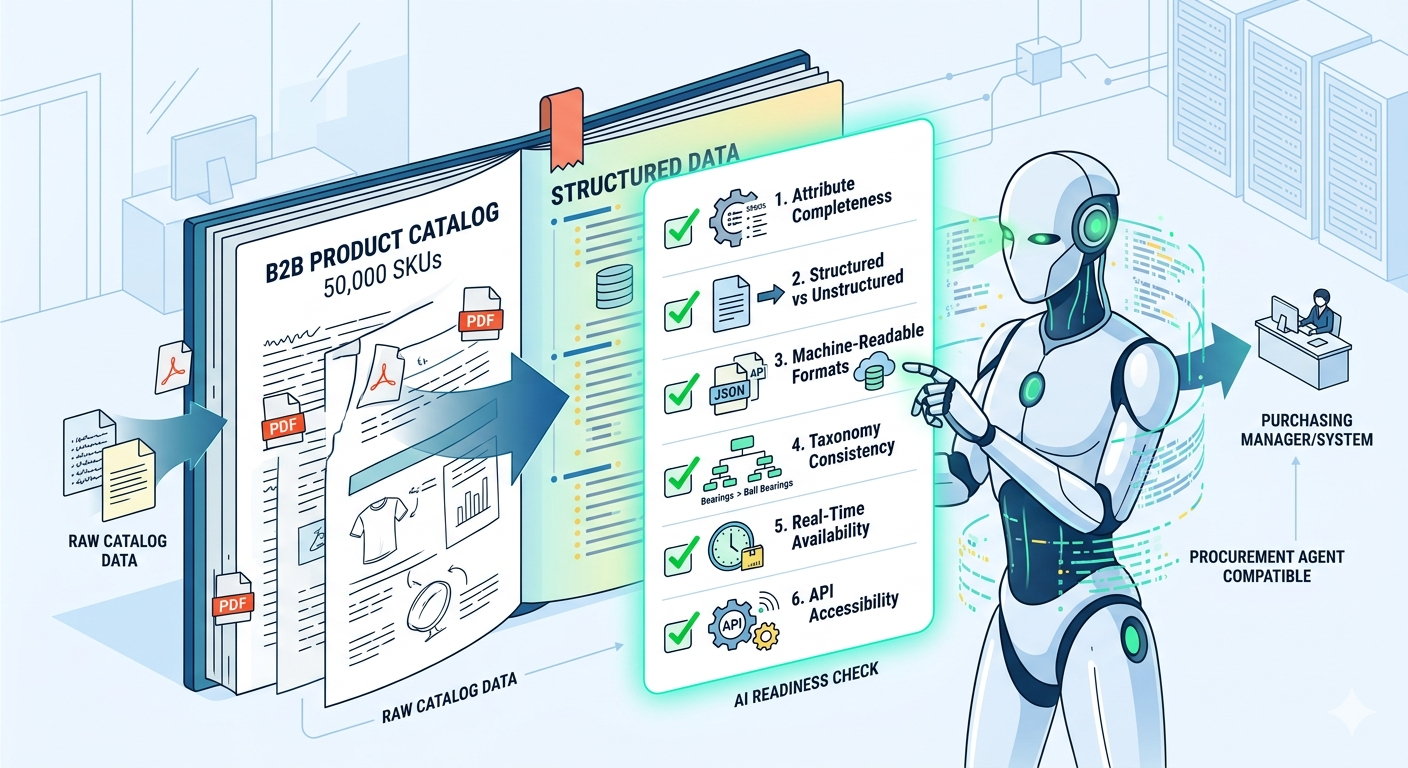
Most B2B distributors and manufacturers would answer "no." The reason isn't that you don't have data, it's that your data exists in forms AI agents can't understand. Product descriptions are narrative prose, not structured attributes. Specifications are in unstructured PDFs, not queryable fields. Taxonomy is inconsistent. Pricing and availability are scattered across multiple databases. Technical relationships between products are undocumented.
From a human perspective, your catalog is fine. From an AI agent's perspective, it's chaos. And here's what happens: AI procurement agents skip your catalog and go to competitors who have structured data.
Why Catalog Readiness Matters
Picture this scenario. A procurement agent receives an RFQ: "50 metric tons of 6061-T6 aluminum alloy sheet, 3/8 inch thickness, 48x96 inch size, anodized finish, delivered within 6 weeks."
Your competitor's catalog:
- Material: 6061-T6 (structured field)
- Thickness: 3/8" (numeric, searchable)
- Dimensions: 48x96" (standardized format)
- Finish: Anodized (structured attribute)
- Availability: Real-time ERP feed
- Lead time: 5 weeks (auto-calculated)
The AI agent matches the spec in 0.3 seconds. Generates a quote. Submits it.
Your catalog:
- Title: "6061-T6 Aluminum Sheeting – Assorted Sizes – Anodized – Premium Grade"
- Description: "High-quality aluminum alloy sheet suitable for structural applications… contact sales for quote"
- Specs: Embedded in a 12-page PDF datasheet
- Lead time: Unknown (salesperson must check)
- Price: Not listed
The AI agent can't parse this. It flags your company for manual follow-up. Your competition got the deal. You never even knew they asked.
This is not a hypothetical. Forrester estimates 20% of B2B procurement will be agent-driven by 2026 — growing to 50% by 2028. Every quarter that passes without catalog readiness is a quarter you're invisible to AI procurement agents.
🗂️ Messy catalog costing you deals you don't even know you're losing? See how ContentPulse transforms unstructured B2B data into an agent-ready catalog →
The AI-Ready Catalog Readiness Checklist
Use this framework to assess your current state across six critical dimensions.
1. Attribute Completeness
What it is: Each SKU has documented, standardized attributes — not narrative descriptions. Examples: material type, dimensions, color, weight, certifications, finish, grade.
✅ Ready Benchmarks:
- At least 15 key attributes per SKU
- Attributes are fields, not hidden in narrative descriptions
- All SKUs in a category have the same attribute set
- Attributes are sourced from product data, not invented during catalog entry
❌ Not Ready Benchmarks:
- Key specs are embedded in narrative text
- Fewer than 5 structured attributes per SKU
- Same product has different attribute values across sales channels
To Assess: Pick 20 random SKUs from your top-selling categories. Count how many have at least 15 documented attributes in structured fields. If it's less than 80%, you're not ready.
2. Structured vs. Unstructured Data
What it is: The percentage of your product information that exists in machine-readable format vs. documents like PDFs, images, and text descriptions.
✅ Ready Benchmarks:
- 70%+ of critical product information is in structured fields
- PDFs are supplementary, not the primary data source
- You can generate a product spec without opening a document
❌ Not Ready Benchmarks:
- Product specs require reading a PDF
- Pricing is documented in marketing material, not a pricing table
- Fewer than 40% of product information is in queryable fields
To Assess: For 10 random SKUs, try to answer these questions without opening any document: What are the dimensions? What certifications does it have? What's the lead time? What material is it made from? What are acceptable substitutes? If you need to open a document for more than 2 of these, you're not ready.
3. Machine-Readable Formats
What it is: Your data is available in formats that APIs and agents can parse — structured JSON, queryable databases, or standardized formats like XML and CSV — not just human-readable PDFs or images.
✅ Ready Benchmarks:
- Product catalog available via API, not just downloadable files
- Real-time availability data covering inventory levels and lead times
- Data format is consistent across all products in a category
- Images have machine-readable metadata
❌ Not Ready Benchmarks:
- Catalog is a PDF or Excel file, not a live data feed
- Availability requires a human to check warehouse systems
- Price lists are separate from inventory data
To Assess: Ask your tech team: Can a third-party system pull real-time inventory via API? Is your catalog updated in real-time or on a batch schedule? Do images have structured metadata tags? If you can't get "yes" to at least 2 of these, you're not ready.
4. Taxonomy Consistency
What it is: Your product categorization and naming conventions are standardized. The same product is called the same thing everywhere. Categories are hierarchical and consistent.
✅ Ready Benchmarks:
- Taxonomy is documented and enforced — not ad-hoc
- Same product doesn't exist under multiple category paths
- Product names follow a consistent pattern (e.g., Material + Size + Finish)
- Taxonomy aligns with industry standards or customer expectations
❌ Not Ready Benchmarks:
- Same product appears under different category names
- Taxonomy varies by sales channel or system
- Product names are inconsistent in abbreviation, unit designation, or descriptor order
To Assess: Take one product family — e.g., ball bearings. Search your catalog for how many different ways it appears. Different category paths? Different naming conventions? Different attribute values for the same SKU across systems? If you find more than one variation per product, you're not ready.
5. Real-Time Availability
What it is: Inventory levels and lead times are live, connected to your ERP, and updated in real-time — not batch-updated or manually managed.
✅ Ready Benchmarks:
- Availability data updates automatically from ERP
- Lead times are calculated based on current demand and supply
- Backorder status is transparent and structured
- Agents can check inventory without human intervention
❌ Not Ready Benchmarks:
- Catalog shows "in stock" but inventory is managed manually elsewhere
- Lead times are static regardless of current demand
- Availability requires a salesperson to check the system
- Inventory is updated end-of-day, not in real-time
To Assess: Can you query current inventory for any SKU via API? Is inventory updated to your catalog within 15 minutes of an ERP change? Do customers see the same inventory status as your sales team? If you answered "no" to more than one, you're not ready.
6. API Accessibility
What it is: Your product catalog is accessible to external systems via API — available for procurement agents to query, integrate, and build on.
✅ Ready Benchmarks:
- You have a published product data API
- API includes search, filtering, and real-time pricing
- API authentication is straightforward
- API is monitored with documented SLAs
❌ Not Ready Benchmarks:
- There is no public API — catalog is internal only
- API exists but is undocumented or poorly maintained
- API is slow (>2 second response time)
- API requires custom integration work per customer
To Assess: Do you have a publicly documented product API? Can an external developer integrate with it in under 1 hour? Does the API support search and filtering? If you don't have an API or it's not easy for third parties to use, you're not ready.
Scoring Your Readiness
For each of the 6 areas, score yourself:
| Score | Criteria |
|---|---|
| 4 points — Fully Ready | 3+ benchmarks checked in the "Ready" list |
| 2 points — Mostly Ready | 2 benchmarks checked in the "Ready" list |
| 1 point — Partially Ready | 1 benchmark checked in the "Ready" list |
| 0 points — Not Ready | None of the benchmarks apply |
Total Score Interpretation:
- 20–24: AI agents can navigate your catalog effectively
- 12–19: Foundational work is done, but gaps remain (6–9 months to full readiness)
- 6–11: Significant work needed; you're invisible to most AI procurement agents (12–18 months to readiness)
- 0–5: Your catalog is not AI-ready — this is a business risk
📊 Not sure where you scored? Let RevPulse run the audit for you — SKU by SKU, in 30 days. See how RevPulse identifies your catalog's revenue leaks and readiness gaps →
What Happens If You're Not Ready
If your catalog isn't AI-ready, procurement agents will skip you entirely — they can't match specs efficiently so they move to competitors with structured data. They'll use guesswork, matching requirements incorrectly and ordering wrong SKUs, leading to returns and customer frustration. They'll go around you, finding your products through competitors' catalogs or industry databases instead of yours. And they'll establish lower price expectations — without accurate specs, buyers negotiate on price instead of value.
In practice, this means you're invisible to the fastest-growing segment of B2B buyers, you lose deals to competitors with better-structured catalogs, and your sales team still has to do the quote work that agents would otherwise handle automatically.
The Path Forward
Most mid-market B2B companies fall into the "Mostly Ready" or "Partially Ready" buckets. You have the data — it just needs structure. The work breaks into three phases.
Phase 1 — Months 1–3: Quick Wins Standardize product naming conventions, document taxonomy and enforce consistency, and audit the top 20% of SKUs that generate 80% of revenue to ensure completeness.
Phase 2 — Months 4–9: Structure & Integration Move critical attributes from documents into structured fields, build or upgrade your product data API, and connect real-time inventory feeds from your ERP.
Phase 3 — Months 10–12: Optimization Augment with AI-powered attribute extraction to handle legacy PDFs, build product relationship intelligence for substitutes and equivalents, and publish catalog readiness metrics to track improvements.
Done well, this transforms your catalog from a sales tool into a procurement platform. Agents can navigate it. Customers prefer ordering through you because you're so discoverable. Your salespeople spend less time on spec work and more time on relationships.
Forrester projects 20% of B2B procurement will be agent-driven by 2026 — growing to 40–50% by 2028. The distributors and manufacturers that act now will own those relationships. The laggards will be scrambling to retrofit catalogs that should have been structured years ago.
🏆 Ready to make your catalog AI-ready? CommerceFlow has processed 100M+ B2B products. We know exactly where to start. Book a 15-minute demo and see ContentPulse build your agent-ready catalog →
CommerceFlow's ContentPulse agent is trained to work with structured catalogs and extract intelligence from unstructured data. We've processed 100M+ products and understand the data challenges that face B2B distributors and manufacturers. Talk to our team →