ACP and UCP: The Two Protocols That Will Define How AI Agents Buy
OpenAI's ACP and Google's UCP are reshaping how AI agents buy. Here's what B2B sellers need to know and the 3 steps to become discoverable

ACP and UCP: The Two Protocols That Will Define How AI Agents Buy
Two protocols are quietly building the infrastructure that will determine how AI agents buy things. If you sell B2B, understanding both is no longer optional.
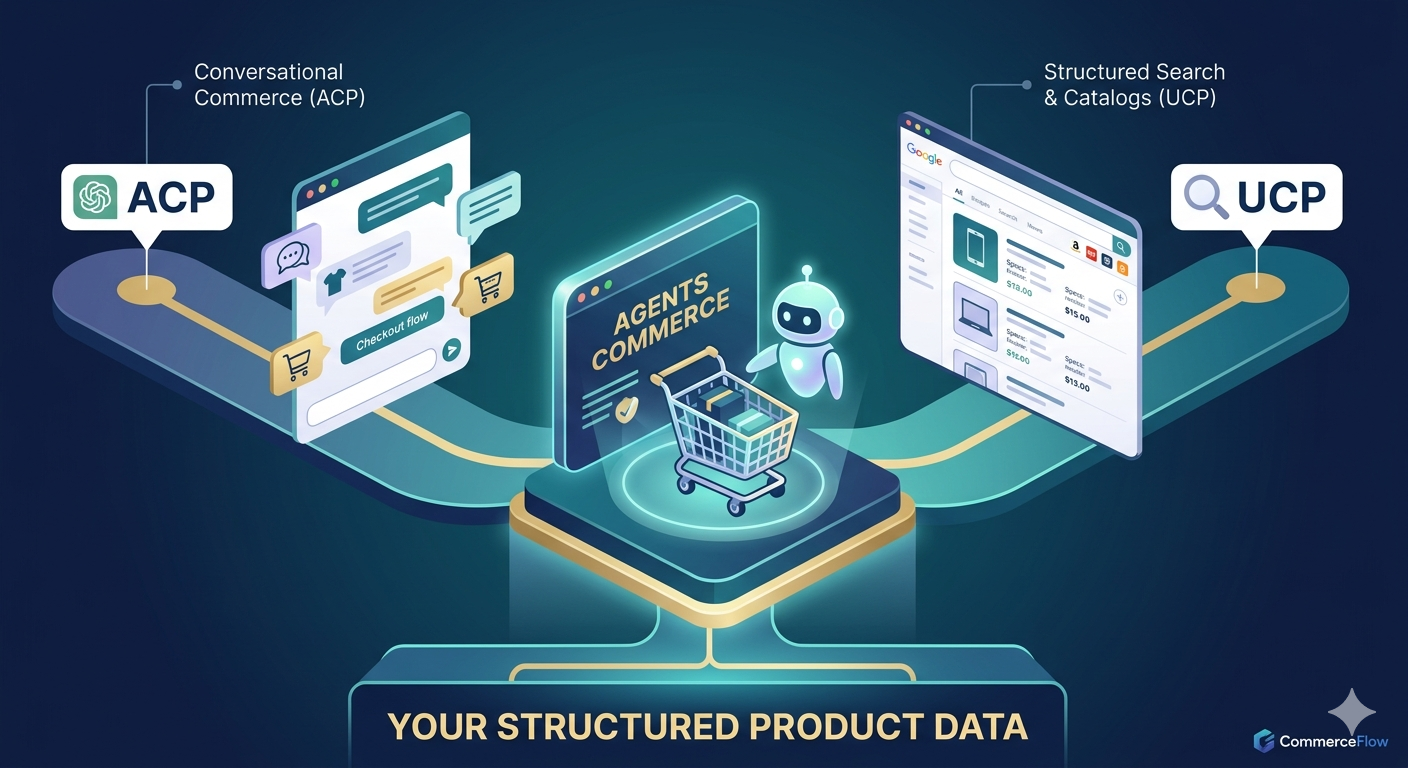
OpenAI's Agentic Commerce Protocol (ACP)
In September 2025, OpenAI launched Instant Checkout inside ChatGPT, powered by the Agentic Commerce Protocol co-developed with Stripe. The system allows AI agents to discover products, compare options, and complete transactions — all within a conversation.
ACP now reaches over 900 million weekly ChatGPT users. Merchants who integrate get their products surfaced when users describe what they need. The AI handles discovery, comparison, and checkout. The human just approves.
Today, ACP is primarily consumer-facing. But the architecture is designed for any commercial transaction. The moment enterprise procurement teams start using ChatGPT for supplier research — which is already happening — sellers with ACP-compatible product data will have a significant advantage.
Google's Universal Commerce Protocol (UCP)
In January 2026, Google announced the Universal Commerce Protocol with backing from Walmart, Target, Shopify, and more than 20 other partners. UCP is integrated into Google Search AI Mode and Gemini, capturing the highest-intent commercial queries on the web.
Where ACP excels at conversational product discovery, UCP captures structured search intent. A procurement manager searching for "high-temperature ceramic fasteners M8 grade 10.9" on Google will increasingly see AI-synthesized results that pull from UCP-connected catalogs.
For B2B sellers, this matters enormously. Technical product searches with specific attribute requirements — the kind that dominate B2B purchasing — are exactly what UCP is designed to handle.
🗂️ ACP. UCP. Both require the same thing: structured, agent-ready product data. Is your catalog ready? See how ContentPulse makes your catalog discoverable to every major AI protocol →
What Both Protocols Have in Common
Despite their different approaches, ACP and UCP share the same fundamental requirement: structured, machine-readable product data.
An AI agent using either protocol cannot work with a PDF catalog. It cannot parse pricing that lives in a sales rep's head. It cannot compare products whose specifications are inconsistent or incomplete.
Both protocols need products described with complete, standardized attributes. Both need real-time pricing and availability. Both need programmatic access to catalog data.
The implication is straightforward: preparing for one protocol largely prepares you for the other. The investment is in your data, not in protocol-specific integration.
Why B2B Sellers Should Pay Attention Now
Enterprise procurement platforms are watching both protocols closely. The major procurement suites — SAP Ariba, Coupa, Jaggaer — are all building AI agent capabilities that will need structured supplier data to function.
When these platforms deploy procurement AI agents at scale, they will pull from whatever structured product databases they can access. Sellers whose catalogs are agent-ready will be discovered, compared, and shortlisted. Sellers whose data is trapped in PDFs and spreadsheets will be invisible.
The timeline is compressed. Gartner's prediction of $15 trillion in AI-agent-commanded B2B purchases by 2028 assumes rapid protocol adoption. Forrester's estimate that 20% of B2B sellers will face agent-led negotiations this year confirms the acceleration.
⚡ 20% of your buyers are already negotiating via AI agents. See how CommerceFlow gets you ahead of them. Explore the CommerceFlow platform built for agentic commerce →
What to Do About It
The practical steps are the same regardless of which protocol dominates.
First, audit your product data for completeness. Every SKU should have structured attributes with consistent taxonomy. Missing data means invisible products.
Second, make your catalog programmatically accessible. API endpoints for product data, pricing, and inventory are becoming table stakes. If procurement AI agents cannot query your catalog, you do not exist in their evaluation set.
Third, automate your quote response. Both protocols enable AI agents to request quotes from multiple suppliers simultaneously. Speed of response becomes a primary selection criterion. Manual quoting processes measured in days will lose to automated responses measured in minutes.
The protocol wars between ACP and UCP will play out over the next several years. But the foundation both require — structured data, programmatic access, instant response — is something B2B sellers can and should build now.
🏆 Structured catalog. Instant quotes. Real-time pricing. CommerceFlow delivers all three in 14 days. Book a 15-minute demo and see CommerceFlow make your business agent-ready →
CommerceFlow helps B2B sellers become agent-ready with AI-powered catalog structuring, instant quoting, and revenue optimization. See how it works →